 Thrive Safe
Walk into any gym, and you'll find creatine on the shelf. Walk into any conversation about supplements, and you'll find an opinion about it — usually one of two extremes. Either it's the only supplement worth taking, or it's something vaguely suspicious that serious, clean athletes avoid.
Both of those positions are wrong. And the truth is far more interesting.
What Creatine Actually Is
Creatine is not an artificial compound invented in a laboratory. It's a naturally occurring substance your body already produces — synthesised in your liver, kidneys, and pancreas from amino acids, and stored primarily in your skeletal muscle. You also get it from food, particularly meat and fish. A typical omnivorous diet provides around one to two grams per day. Your body makes roughly the same amount again.
A creatine supplement does one thing: it saturates your muscle creatine stores beyond what diet and natural production typically achieve. That's it. No hormones. No synthetic pathways. Just more of something your body already makes and uses.
What It Actually Does
Creatine's job in the body is to help regenerate ATP — adenosine triphosphate — which is the molecule your muscles use for energy. During the first few seconds of intense, explosive effort — a sprint, a heavy lift, a fast change of direction — your body burns through ATP faster than it can produce it from other sources. Creatine phosphate steps in as a rapid buffer, allowing that intense effort to continue a little longer before fatigue sets in.
The practical result: marginally more reps, slightly faster sprints, quicker recovery between high-intensity efforts. The effect is real but not dramatic — creatine won't transform someone who doesn't train. It gives people who already work hard a measurable edge.
What the Research Actually Says
This is where creatine becomes unusual, because the research is surprisingly consistent.
Creatine monohydrate has been studied in sports science since the early 1990s. The body of evidence supporting its effectiveness for high-intensity, short-duration exercise is substantial — not substantial for a supplement, but substantial by the standards of nutritional science generally. Meta-analyses consistently find meaningful improvements in strength and power output in people who supplement with it alongside resistance training.
The International Society of Sports Nutrition considers creatine monohydrate the most effective ergogenic nutritional supplement currently available for increasing high-intensity exercise capacity.
That's a strong statement from a careful organisation. It's worth taking seriously.
The Reputation Problem
So why does creatine still carry a shadow of suspicion for many people?
Several reasons, none of them well-founded.
It looks like it belongs next to steroids. On supplement store shelves, creatine sits alongside products making extraordinary claims — fat burners, testosterone boosters, pre-workouts with aggressive branding. Guilt by association is real, even when it's irrational.
Early concerns about kidney damage. These were based on misunderstood early studies and theoretical mechanisms that haven't borne out in the research. Current evidence consistently shows creatine supplementation is safe for healthy adults at standard doses. People with pre-existing kidney conditions should consult a doctor before taking it, as with any supplement — but for healthy adults, the concern is not supported by the available evidence.
It's not natural. Except it is. Your body makes it every day.
It causes water retention. This one is actually true — creatine draws water into muscle cells, which can cause a small increase in body weight. Whether this is a problem depends entirely on what you're trying to achieve. For most people doing resistance training, it isn't.
The Marketing Problem
Here's where things get interesting from a consumer intelligence perspective.
Creatine monohydrate — the original, plain, well-evidenced form — is cheap. Genuinely cheap. A month's supply from a reputable supplier typically costs a few pounds.
The supplement industry's response to this has been to develop and heavily market alternative forms: creatine HCl, buffered creatine (Kre-Alkalyn), creatine ethyl ester, and various proprietary blends sold at significantly higher prices.
The marketing claims for these alternatives — better absorption, fewer side effects, superior performance — are generally not well-supported by independent research. The comparative studies that exist tend to show creatine monohydrate performing at least as well, often better, at a fraction of the cost.
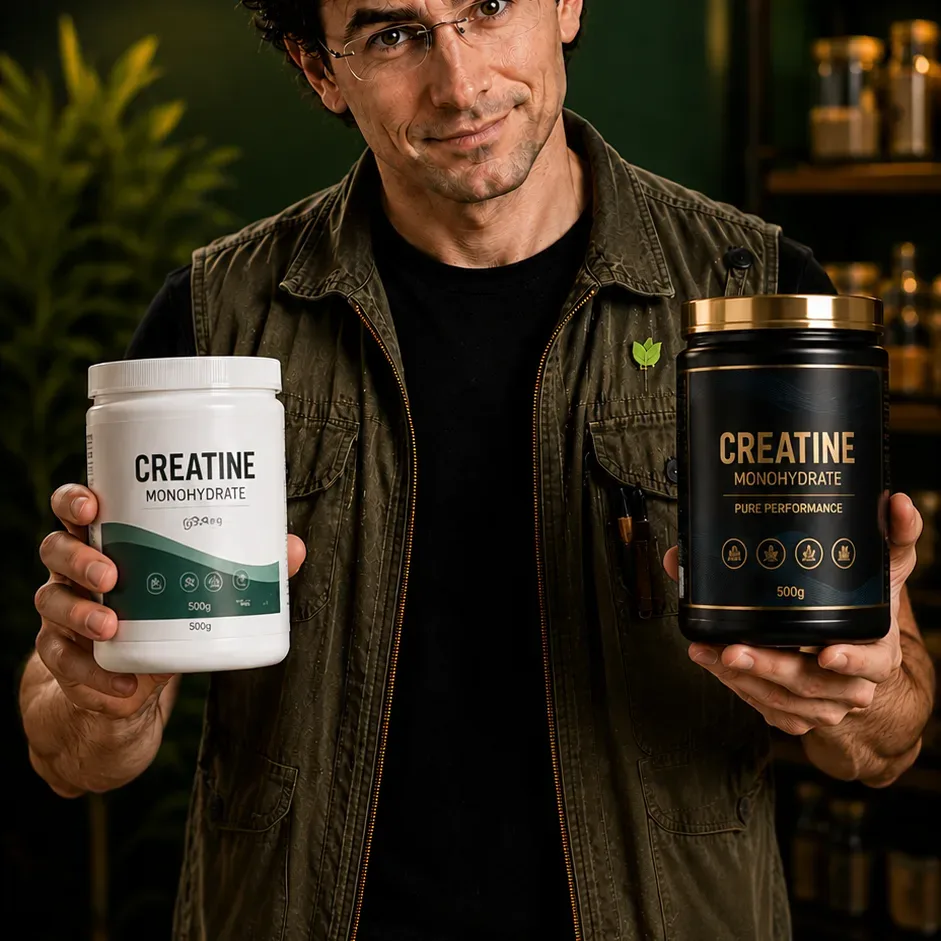
This is a case where the premium product is not delivering premium results. The expensive tub and the plain, cheap one contain what is, for most people, effectively the same compound — with the same effect.
What's Genuinely Interesting: Beyond the Gym
Something worth watching is the emerging research into creatine's effects beyond athletic performance.
Studies are exploring its potential role in cognitive function, particularly under conditions of sleep deprivation or mental fatigue. Research into its relevance for older adults — where natural creatine stores decline and muscle loss becomes a health concern — is also developing. And there is early-stage investigation into its potential relevance in neurological health.
None of this is established enough to make strong claims about. But it does suggest that creatine's story isn't only a gym story — and that the conversation about it is likely to evolve.
What to Actually Look For
If you're considering creatine:
- Creatine monohydrate is the form with the most evidence behind it. Don't pay more for alternatives unless you have a specific, evidence-supported reason to.
- Micronised creatine monohydrate dissolves more easily in water — a practical improvement, not a performance one.
- Third-party tested products (look for Informed Sport, NSF, or similar certification) are worth seeking out if you're subject to drug testing or simply want confidence in what's in the tub.
- Dosing: most research uses three to five grams per day. Loading phases (higher doses for the first week) can saturate stores faster but aren't necessary.
- Timing: the research on timing is mixed. Consistency matters more than when you take it.
The Thrive Safe Moment
Creatine is one of those rare cases where the cheap, unglamorous option is also the best-evidenced one. The marketing around supplements often works hardest precisely where the evidence is weakest — and creatine is a perfect illustration of that dynamic.
Understanding what you're buying doesn't mean being suspicious of everything. It means being able to tell the difference between a product backed by real evidence and one backed by an impressive-looking tub.
That's the whole point of Thrive Safe.
I'm Professor Sage.
And remember — curiosity is healthier than fear.
Want to understand what you are really buying? Try Thrive Safe — free, at thrivesafe.app.